Ella Road (2010, English) is an award-winning playwright and screenwriter whose credits include Black Mirror and Doctor Who. Her new play, Robota, is the first full-scale theatrical production to be staged at the Schwarzman Centre for the Humanities, home to Oxford University’s Centre for Ethics and AI.
Ella kindly joined us on the last day of rehearsals to talk about the inspiration behind her new play. Robota is a bold adaptation of the 1920 play by Karel Čapek which coined the term ‘robot’. Ella’s 2026 version uses Čapek’s text as a jumping-off point to ask urgent questions about big tech, the uncanny valley of AI, and how everything — including the stories we tell, and even our relationships— is governed by algorithm.
Described by WhatsOnStage as “a thrilling adventure, a brilliant introduction to a great new theatre, and a genuine springboard for discussion”, Robota is running at the Schwarzman Centre until 18 July. You can buy tickets here.
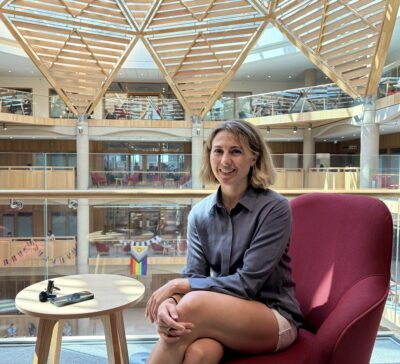
Ella Road at the Schwarzman
Your plays often put big ideas front and centre, whether that’s AI, gender in sport or genetic ethics. Do you think that art can change anything by engaging with topics like these?
I think theatre has always been the forum where we discuss things that feel relevant to being alive, whether that’s love or war or an ailing king. It’s also always been the place where we go to model different scenarios and warn people against behaving in certain ways. Historically, people went to the theatre to be educated, and I think it still serves that function today. At the same time, I don’t know if it is important for art to change the world. It’s also just a necessary part of our culture as humans to tell stories and explore alternate realities in order to understand what we want to do or should do, or dream of doing. The theatre is a place where everyone can explore that.
I was fascinated by the idea that, even though I know that I am different to an AI, I can’t prove it.
Are there any strategies you use either in writing or rehearsals to make sure the balance of ideas to human interest or narrative pace is right?
I think that just comes in drafting and editing. There are always too many ideas, too much academic stuff in the first draft, maybe even the second. For me at least, the drafting process is often just cutting down to try and get the rhythm right. And always, even in production, you find that you’re cutting more because you realise that a lot of the themes or questions or political statements are held within the performance of the piece and they no longer need to be spoken.
The 1920 play that inspired Robota was written without an awareness of AI. How did your awareness of contemporary developments in AI affect the play and how you felt about the characters and themes?
It’s probably important to note here that I haven’t used a lot of the characters from Čapek’s original, and the ones that I have kept I’ve really repurposed for my own use. We start in a similar place in Act One, then it goes on a wild and bizarre journey, before landing up somewhere quite similar at the end. And that middle section is where I was thinking about AI.

Ronkẹ Adékọluẹ́jọ́ and Umi Myers in ‘Robota’, © Helen Murray
And how did your research into AI shape how you felt about the character and themes of the play?
I got really fascinated basically by trying to drill down into what the difference is between the way that we think and how the algorithms that we programmed think. And the more research I did – including speaking to philosophers here at the Schwarzman – the more I realised that you can’t ever know what consciousness is and no one has actually ever come up with a satisfactory definition or way of testing it. So I was fascinated by the idea that, even though I know that I am different to an AI, I can’t prove it.
Did research influence your decision to focus more on the possibility of a gendered exploitation of AI? I’m thinking here about the gendered ending of the play’s title and the blurring of the human and robot female lead, Helen.
Definitely. I think that the fact that the gender politics in the original play are so dated spurred me on to explore gender as a central theme, and the research bore out the assumption that living in a patriarchy means that the people who are disproportionately impacted by AI are women. I did some quite deep dives in my research into deep fake pornography, and I particularly recommend Laura Bates’ The New Age of Sexism. All of it pointed to the fact that women are the ones who suffer most because of AI. Even the fact that the AI is coded overwhelmingly by men and based off inherently misogynistic datasets from the public domain means that, as a woman, you are essentially on the receiving end of discrimination all the time.
To be entirely honest, Robota didn’t have enough space in it for all of this. I’ve tried to feed in as many themes as felt relevant and which the play could carry without overpowering it. But Robota is in many ways a big comedic romp as well as being a kind of epic sci-fi thing, so I had to be careful.
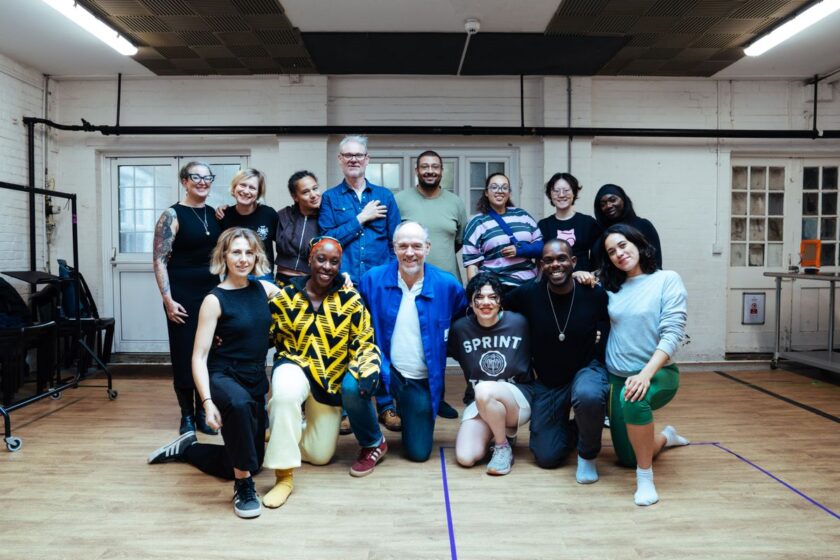
The ‘Robota’ cast in rehearsal earlier this year. © Helen Murray
Are you troubled by the thought of a post-human intelligence that replaces humanity or do you embrace it as Robota perhaps does?
As a human being, I feel very uncomfortable about the idea of a post-human society and I imagine that’s a very natural biological aversion. But I also think it’s too late to have that aversion, because we’re already sharing our society with another intelligent non-human being. There seems to be a lot of disagreement among experts and the CEOs who run these companies as to whether Artificial General Intelligence is a year away, four years away or already here. But either way, the horse has already bolted, you know? That means it’s not about being for or against AI. It’s about how we choose to interact with it, or collaborate with it, or mitigate its influence. At bottom, of course, AI is a reflection of ourselves and how we shape it, so if we want to live with it, we need to do some pretty quick changes to the society we’re living in.
And are you confident about our governments’ or the tech sector’s ability to regulate AI?
I’m generally fairly cynical about our ability to regulate those sorts of oligarchical structures. You know, have we managed to regulate oil or curb climate change? We’re never going to win against big tech through debates or voluntary regulation, because of the profit imperative and their shareholders. It has to be regulation, and we’ll have to force it from the bottom up.
You’ve worked with Chris Chibnall on Doctor Who and Charlie Brooker on Black Mirror, show-runners behind two enormously successful and well-loved franchises. Are collaborations an important part of a modern writer’s toolkit, and what do you gain from them?
I don’t think all writers should collaborate. For me, it’s been an important part of my toolkit because I’ve learned loads and it’s also enabled me to work on really big things quite early in my career, in a very competitive industry. So it was worth it for me, if only because it meant I was given a seat at the table by more experienced creatives. I also had a lot of creative license on both of those projects; I was able to come up with my own ideas and make them, and that was really cool. Still, I don’t think it’s necessarily right for everyone, it just worked for me.
How did reading English at Somerville influence your development as a writer and performer?
I definitely spent a lot of time when I probably should have been in the library making plays, as lots of people do. But my tutors, Fiona Stafford and Annie Sutherland, were also really supportive. I used to tell them all about the plays I was doing. Then, when I won my place at the Oxford School of Drama, Somerville was brilliant: they gave me a grant to support me pursuing this slightly crazy creative dream, and it massively helped with my fees. It was a very encouraging sort of goodbye and good luck!
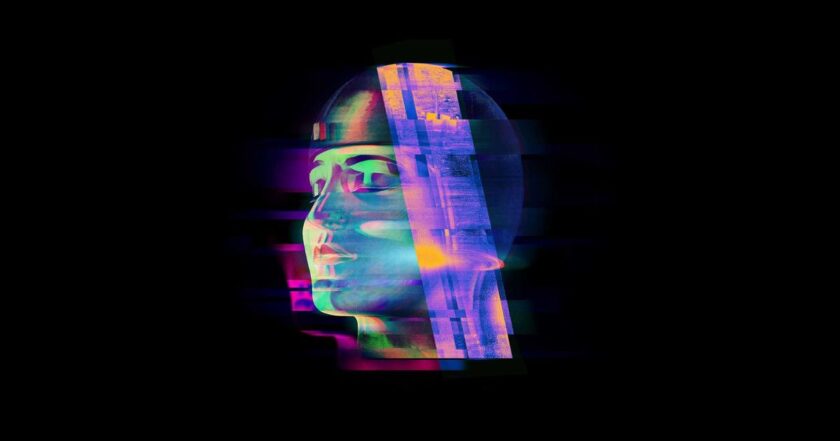
‘Robota’ artwork, courtesy of Headlong and Schwarzman Centre for Humanities