On the advent of his retirement this summer, Somerville College’s Treasurer Andrew Parker joined us to reflect on fourteen successful years at Somerville.
Andrew Parker joined Somerville as treasurer and domestic bursar in January 2013. Since then, he has presided over unprecedented growth in the college finances, delivered major capital projects, expanded the Somerville estate, taken College through COVID safely and without redundancies, and overseen Somerville’s divestment from fossil fuels. Andrew kindly gave up his time to answer some questions about his career journey and the highlights of his time at Somerville.
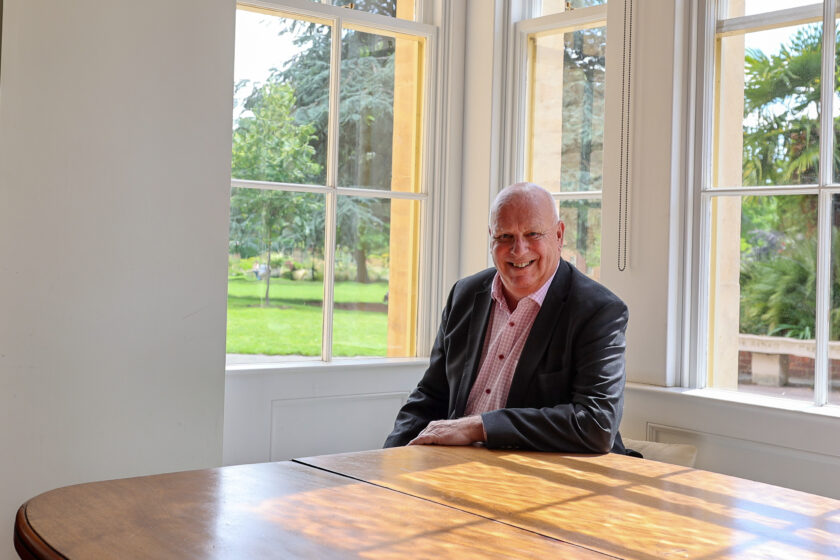
Andrew Parker in the Mary Somerville Room, formerly the JCR bar, at Somerville College, June 2026
You arrived at Somerville in January 2013. Where had you come to us from and what motivated your decision to work here?
AP: I came to Somerville from the Royal Shakespeare Company, where I had been since 2001 in a role equivalent to Chief Operating Officer. In effect, I was doing a very similar role to the one at Somerville for the RSC, but in a bigger organisation. That was brilliant fun, actually. During my time, we oversaw the redevelopment of the main theatre, I was working alongside wonderful, inspirational people, and the RSC had a national profile. That meant every time we started a new run or tour, it was national news, so the focus for us was relentlessly on the next big project.
What prompted your move to Somerville?
AP: It was a good time to move on. There were three of us directors at the RSC: the artistic director, the executive director and me. Artistic directors tend to burn out after around 10 years, and when Michael Boyd announced he wanted to leave, the executive director also decided to go. I could have stayed on and started again with new people, but after 11 really intense, brilliant years, I wanted to end on a high and try something else.
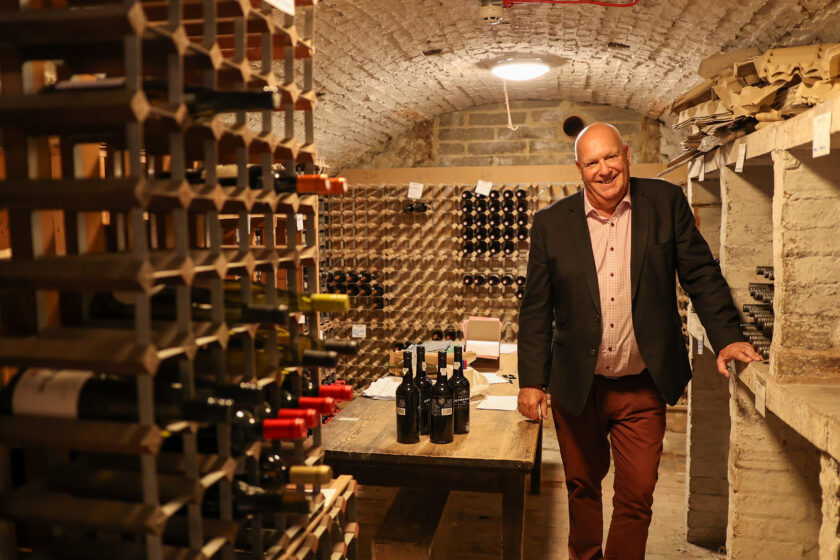
Andrew in the Somerville College wine cellar, June 2026
And what about the pull factor – what brought you to Somerville?
AP: For the whole of my working life, apart from six years at the beginning, I’ve worked for organisations that are values-driven rather than finance-driven, where the finances are the servant rather than the master. I was at the OUP for 12 years, then the RSC, then a friend told me about this job. Somerville appealed to me immediately as another values-driven institution: a proper organisation doing good work and behaving properly.
And what were your first impressions of Somerville when you got here?
AP: It certainly felt smaller than the RSC. But I soon realised that the benefit of being smaller is the different relationships you can build, and the kind of impact you can have. I also came to appreciate that there’s a different rhythm to working in Oxford, one that is quite unique and rather special. The cycle is annual, measured by the terms and punctuated by familiar touchpoints like matriculation, vacation residence, exams and graduation, each of which you come to recognise and welcome as they come around again.
When you first arrived at Somerville, did you have any particular aspirations as treasurer?
AP: The thing I’ve always done wherever I’ve worked has been to trust and empower the people reporting to me. When I first arrived at Somerville, all of my direct reports were very cautious. It took me months, if not years, to change that culture. I had to keep reassuring my team that I really meant it when I said I wanted to hear their opinions, and would trust them and support them in doing their jobs. There’s a real skill in devolving responsibility to your reports. You’ve got to trust them, but also keep enough contact so you know when to intervene if you need to. So that’s probably one of the things I’m proudest of from my time at Somerville: my managers are now proactive, they take responsibility and they show initiative.
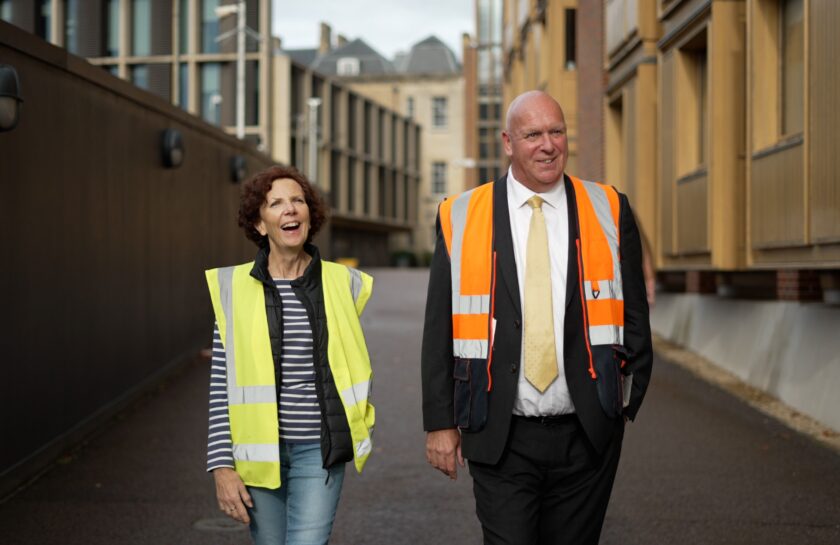
Andrew and former Principal Jan Royall visit the site of the Ratan Tata Building
And how did you adapt to the particular culture of Somerville?
AP: To be honest, I was slightly nervous! I’ve always been quite successful wherever I’ve been, but I was worried that I might not be successful in an Oxford college environment, surrounded by all of these highly intelligent people. Even Treasurers have imposter syndrome!
Was there a moment when you had to present to GB and lay it all on the line, as it were?
AP: Yes, actually. There was a significant change to the estate that happened quite early on. I saw an opportunity to exploit two favourable conditions: first, the availability of long-term money at extremely beneficial rates and, second, the owner of the shops at the south-west side of the Somerville estate wanting to sell. This put us in the happy position of having an opportunity to grow the Somerville estate and the wherewithal to pay for it. However, that meant I had to go to Governing Body fairly early on in my tenure and say, “I’d like to borrow £25 million for 30 years, please, and this is what I’d like to do with it.” That was an early make-or-break moment, because under the peculiar governance model of an Oxford college, you have to stand in front of this very large group of fiercely intelligent people and ask them to decide if they’re going to trust you or not. Fortunately, they did.
You’ve presided over unprecedented growth in the college finances, with Somerville’s endowment almost trebling under your tenure. What’s the secret behind this growth?
AP: I think there are two reasons. The first one is what we just talked about, which is that we took advantage of long-term money to buy the freehold on the south-western corner of the site, which included seven shops, three flats and the Barbara Craig Building. We also used the long-term money to develop the Catherine Hughes Building. All of this changed the estate’s money-making capacity, because you get rent from the shops and the student accommodation.
In parallel to that, there’s the transformative fundraising which makes Somerville so exceptional. First, there was the work of Liz Cooke, whose masterly engagement with alumni resulted in really strong alumni engagement and led to a golden age of residual legacies for the College. Then you’ve got the sector-leading fundraising of Sara Kalim and her team, whose work across alumni and focused fundraising for the MTST and OICSD has resulted in three, four, five million pounds coming into College every year. When you combine that income with OUEM, one of our endowment managers, delivering underlying compound investment growth of 10% pa, the numbers grow really quickly. So, in summary, I’d really like to give credit to all the people who made this growth possible: Sara and her team, our Principals Alice Prochaska, Jan Royall and Catherine Royle, and all of our amazing alumni and donors whose support has been so transformative over the years.
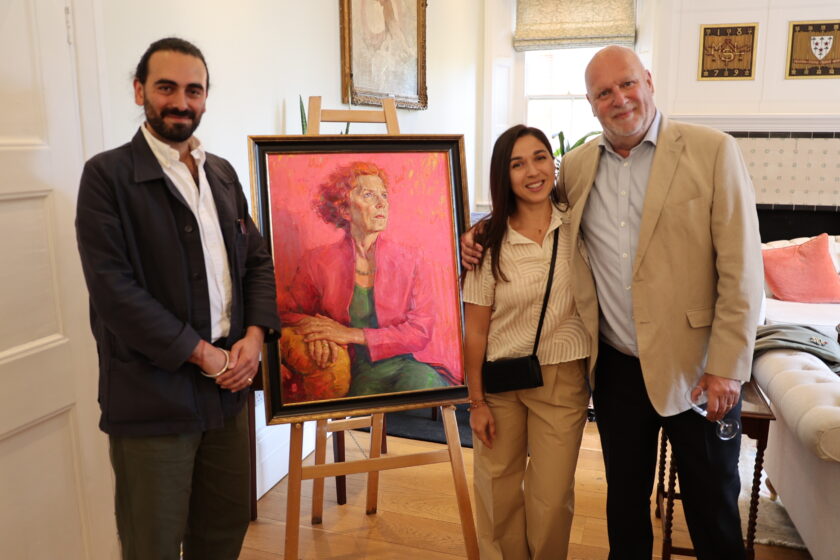
Somerville Associate Dr James Kirkpatrick with portait artist Tania Rivilis and Andrew, June 2025
You’ve achieved a great deal during your 13 years at Somerville: you’ve delivered major capital projects, expanded the Somerville estate, boosted our financial standing, got us through COVID safely and without redundancies, and overseen Somerville’s divestment from fossil fuels. What do you think of as your proudest achievement during your time here?
AP: The change in the endowment has been transformative because it takes day-to-day pressure off and allows College to respond more expansively to proposals. We’ve been able to do more for our students and our academics and we’ve been able to expand headcount to deliver an enhanced service. In terms of the estate, the Catherine Hughes building project was a very happy experience. We had a really lovely quality of design, the space where it fitted into the college is very comfortable and the project itself was very well managed. Most of all, I think the finished building is happy: it’s quirky and interesting, it enables our students to live in College throughout their degrees, and they seem to really like it.
What else? I’m also very proud of the Mary Somerville Room. We took that from a dingy JCR bar to a really elegant room. Lastly, I was really pleased with the portrait we commissioned of Jan (Royall, Principal 2017-25). That was a really lovely, creative process. We chose the right artist to match Jan’s personality, and I think the finished article really captures her amazing vibrancy. It meant a lot to me that we were able to get the portrait right, because Jan did so much to create the culture here. She enabled all of us to be the best people we could be and to do the best job that we could do.
So what next for Andrew Parker?
Andrew: In the short term, it’s travel. We’ve just bought a shiny new camper van and the idea is to do extended trips around Europe and Scandinavia. After that, I’m not sure. I’ve done a lot of pro bono stuff over the years. I was Chair of Governors at my kids’ school, I sat on the board of the Oxford Playhouse and was Vice Chair of Mountview Academy of Dramatic Arts, so I might do some more of that. In the first instance, though, I’m going to take six months off then see how I feel.
That seems a good open-ended note on which to end.
AP: Yes, it does.
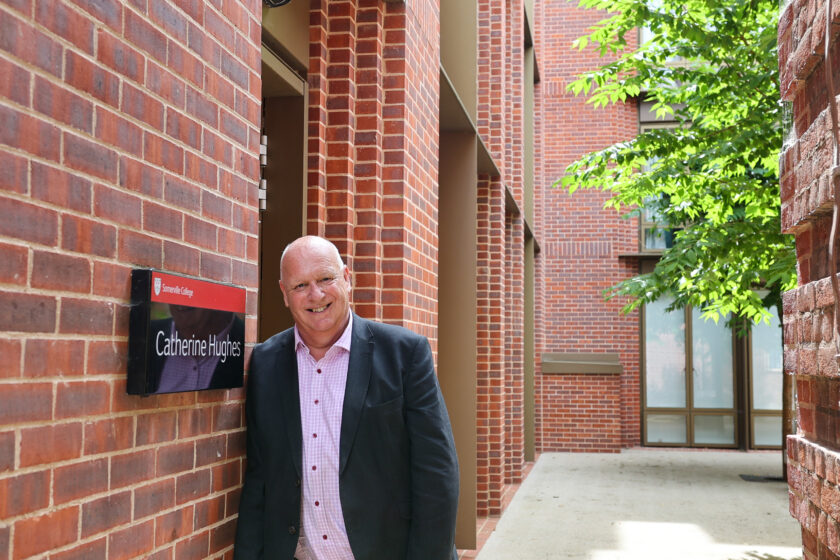
Andrew stands outside the Catherine Hughes Building, opened 2019