Two Somerville fellows have teamed up with colleagues from the Department of Engineering Science to develop an AI framework that generates near-instant predictions of the droplet size distributions critical to many modern engineering applications.
Somerville’s Tutorial Fellow in Engineering Professor Konstantina Vogiatzaki and Professorial Fellow in Machine Learning Steve Roberts collaborated with Postdoctoral Research Assistant Dr Giovanni Tretola (first author in this work) and recent graduate Luke Vernon to develop the pioneering artificial intelligence framework.
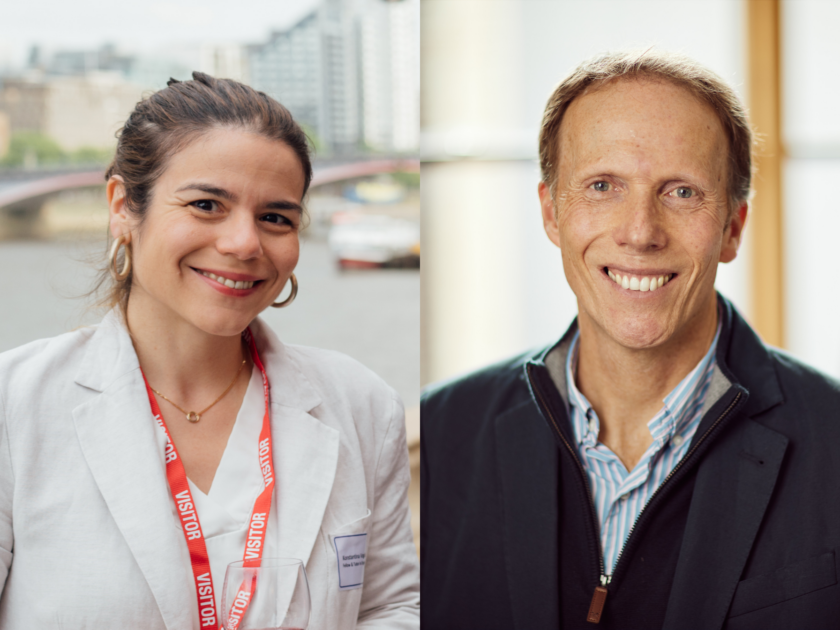
Professors Vogiatzaki and Roberts
The study, led by Professor Vogiatzaki, focuses on “jet-in-crossflow” sprays, where a liquid jet is injected into a fast-moving gas stream. These sprays are widely used in technologies ranging from aircraft engines and industrial cooling systems to fuel injection and clean-energy applications.
One of the biggest challenges in understanding sprays is predicting the sizes of the droplets they produce. Droplet size affects how efficiently fuels burn, how cooling systems perform, and how pollutants spread. However, accurately modelling these microscopic droplets traditionally requires computationally intensive simulations that take hundreds of simulation hours.
The Oxford team tackled this challenge by combining high-fidelity fluid simulations with deep learning. Their new two-stage AI system learns how to connect large-scale spray images – the visible “macroscopic” behaviour of the jet – with the underlying microscopic droplet-size distributions.
The researchers trained the system using thousands of synthetic images generated from advanced large eddy simulations (LES), a state-of-the-art computational fluid dynamics technique. The AI first analyses spray images to identify key flow conditions, before predicting the full distribution of droplet sizes and associated uncertainties.
Crucially, the framework can produce results in seconds while maintaining high accuracy, reducing computational cost by more than 99.9% compared with conventional simulation methods. With future experimental use in mind, the researchers believe the method could help engineers design more efficient combustion systems, improve industrial spraying technologies, and accelerate the development of lower-emission energy systems.
Professor Vogiatzaki commented, “What is exciting about this work is that we demonstrated, for the first time, that macroscopic synthetic image data can be used to accurately predict microscopic droplet statistics almost instantly. Traditionally, obtaining this type of information would require very expensive numerical simulations running for hundreds of simulations hours.”
Professor Stephen Roberts added that: “This work showcases beautifully how AI can augment and accelerate excellent science and engineering. Obtaining higher-accuracy results at a tiny fraction of the compute cost is a real achievement.”
The initial steps of the work were carried out by Luke Vernon, a recent graduate of the Oxford MEng undergraduate course as part of his 4th year research project. In its uniquely collaborative dynamic – both interdisciplinary and intergenerational – this project highlights how Somerville, and Oxford more broadly, bring together people in transformative new combinations.
Story derived from the original with thanks to the Department of Engineering Science.
Read the full paper “A Computational Framework for Droplet Size Distribution in Liquid Jets into Crossflow via Deep Learning and Image-Based Analysis” here.