For the past few years, spring at Somerville has been heralded by the return of a pair of mistle thrushes, who reliably turn up to nest in College.
As this year’s chicks have recently hatched in their precarious new nest within a column on the side of Maitland, watched with baited breath by the entire Somerville community, we thought we’d share this lovely piece by second-year Biologist Nel Wickins. Originally written for student newspaper The Somervillian, it offers a deep dive into the unusual name of these beautiful birds…
The mistle thrush, with its flattering Latin name of Turdus viscivorous, holds the title as the UK’s largest songbird, with a fittingly harsh bellowing call that travels far and wide in late winter and early spring. What it does not possess in musicality, the mistle thrush makes up for in volume. Whilst similar in appearance to the song thrush with its black-spotted white chest and belly, the mistle thrush is much larger and its white underwing makes it distinctive in flight. You may have chanced to see Somerville’s resident pair of birds busy around quad and building their nest. Their upright stance lends them a distinctive confidence, unperturbed by the students wandering back and forth through their territory.
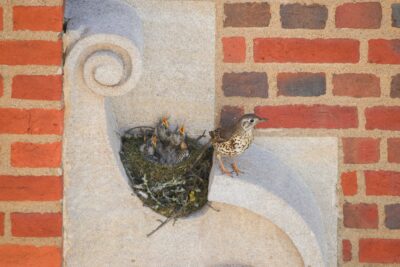
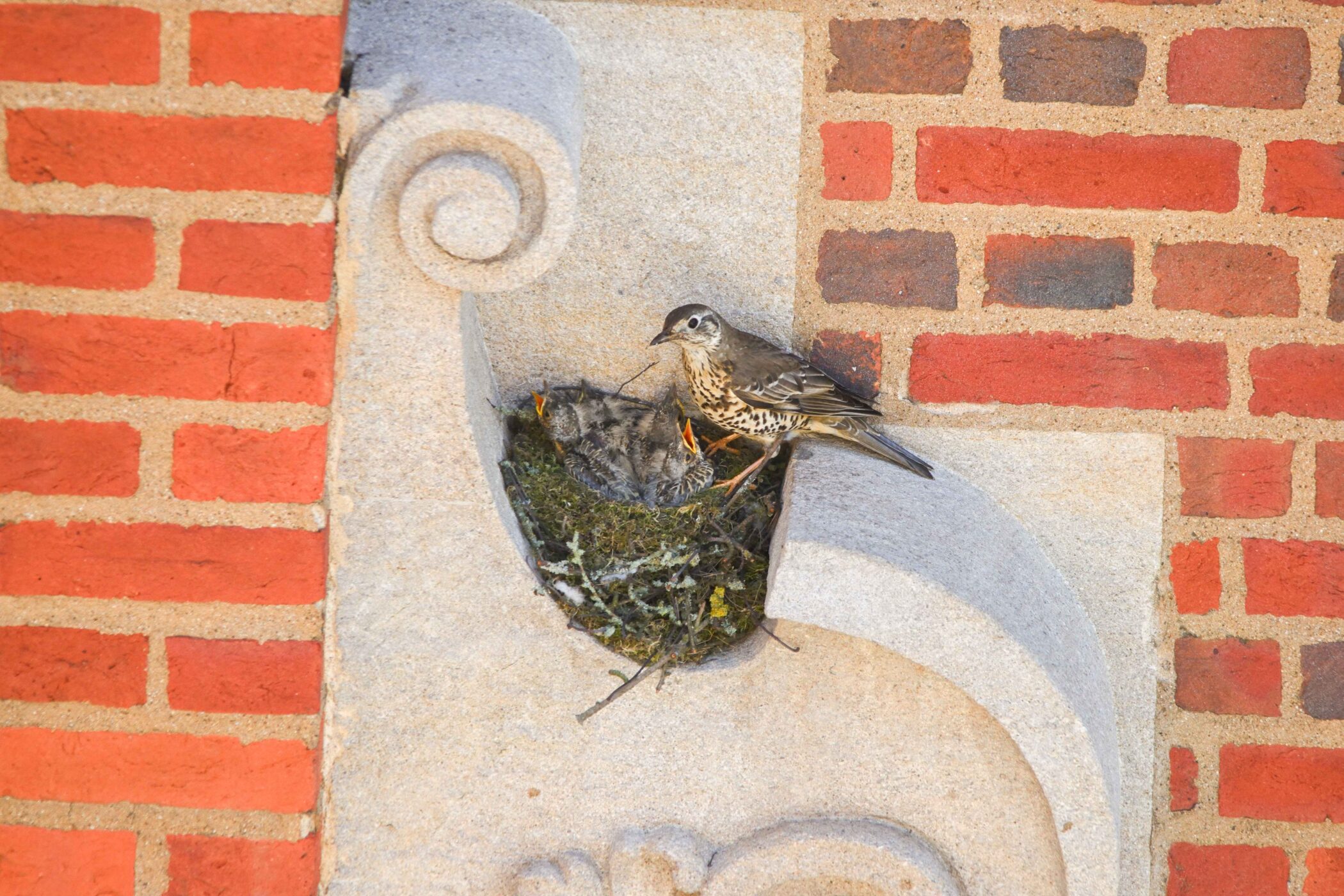 The mistle thrush chicks with one of their parents. Credit: Douglas Lewns
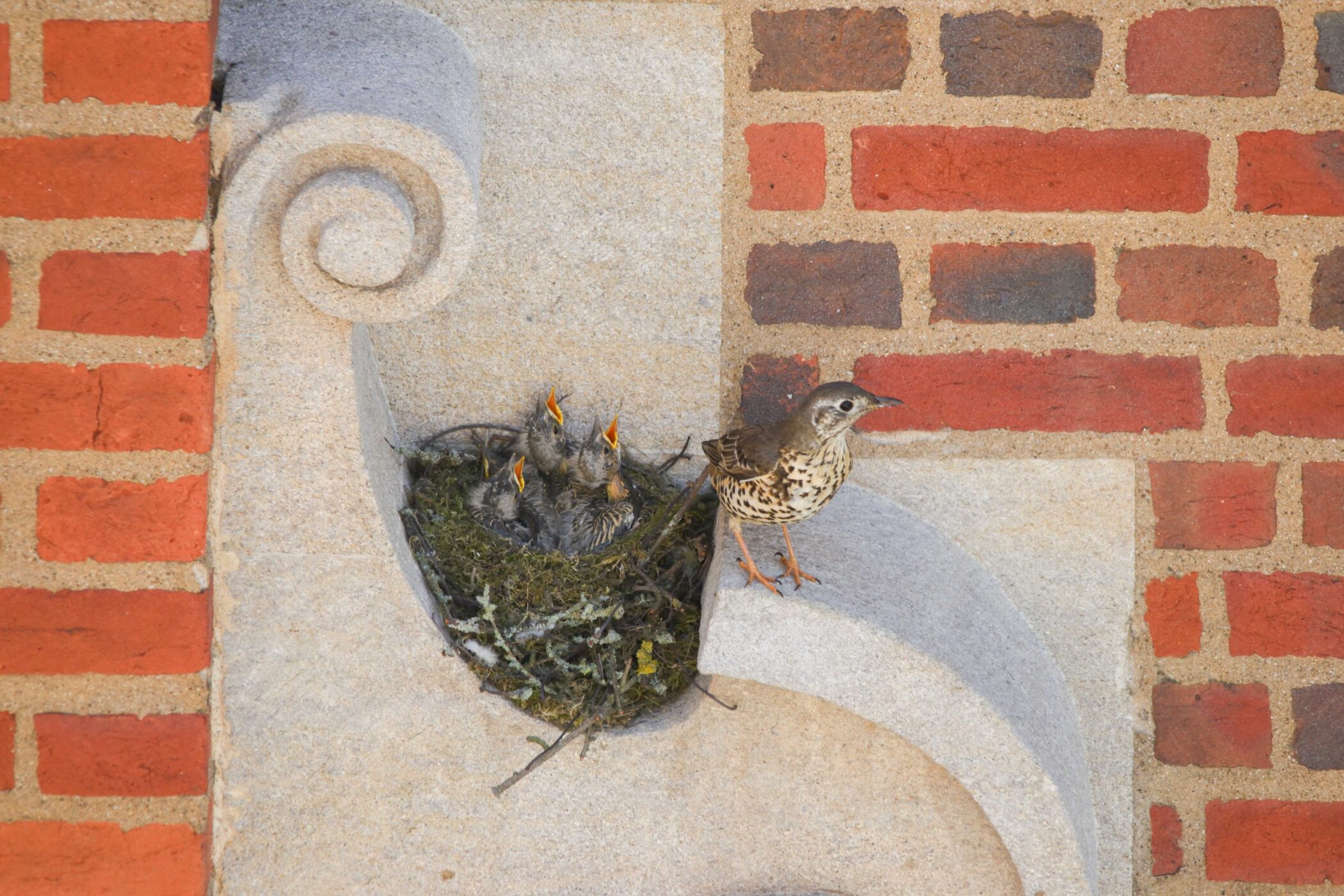 The mistle thrush chicks with one of their parents. Douglas Lewns
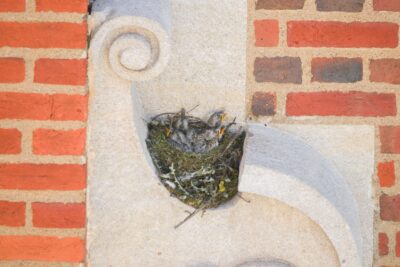
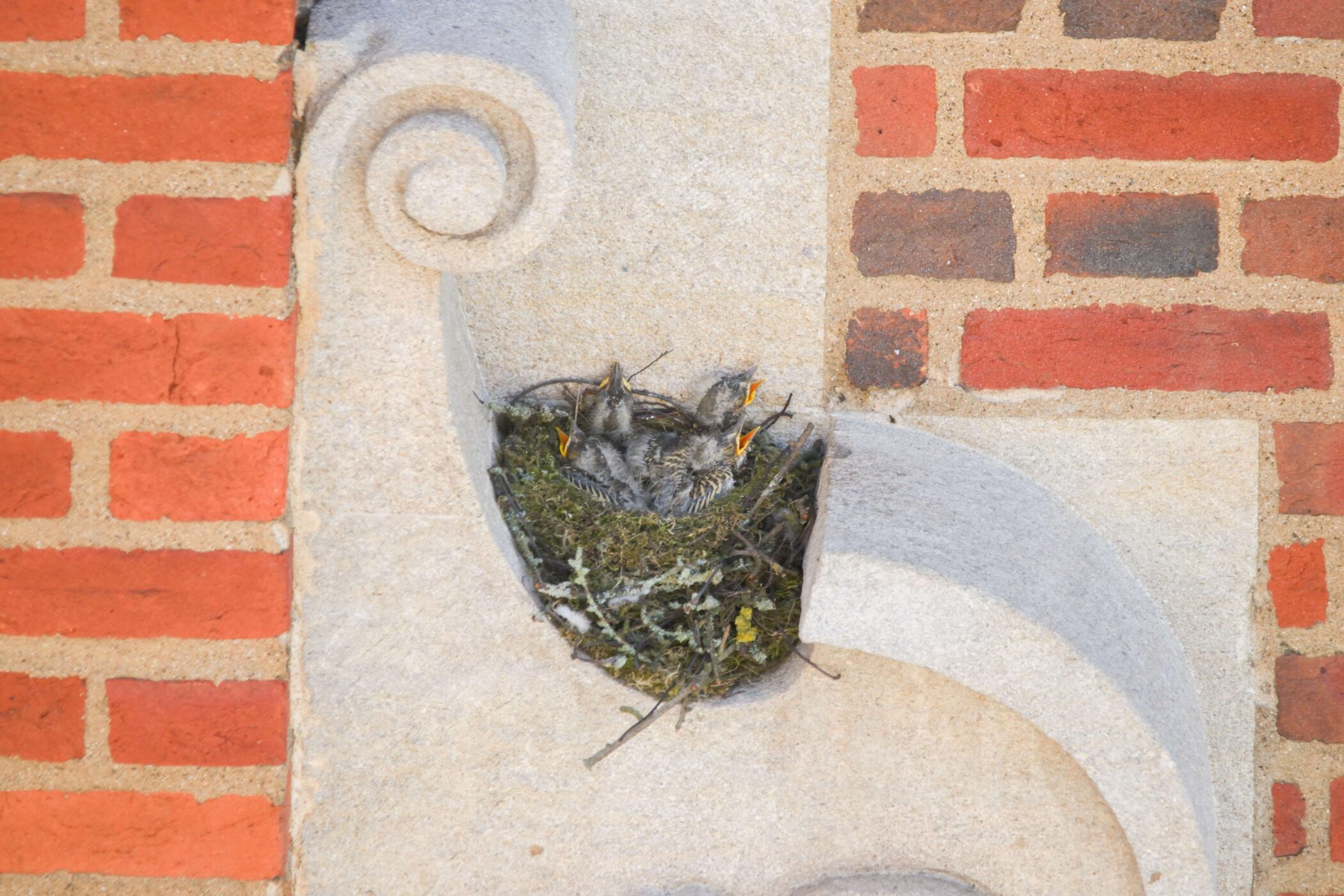 The mistle thrush chicks. Douglas Lewns
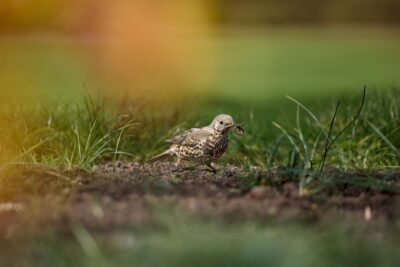
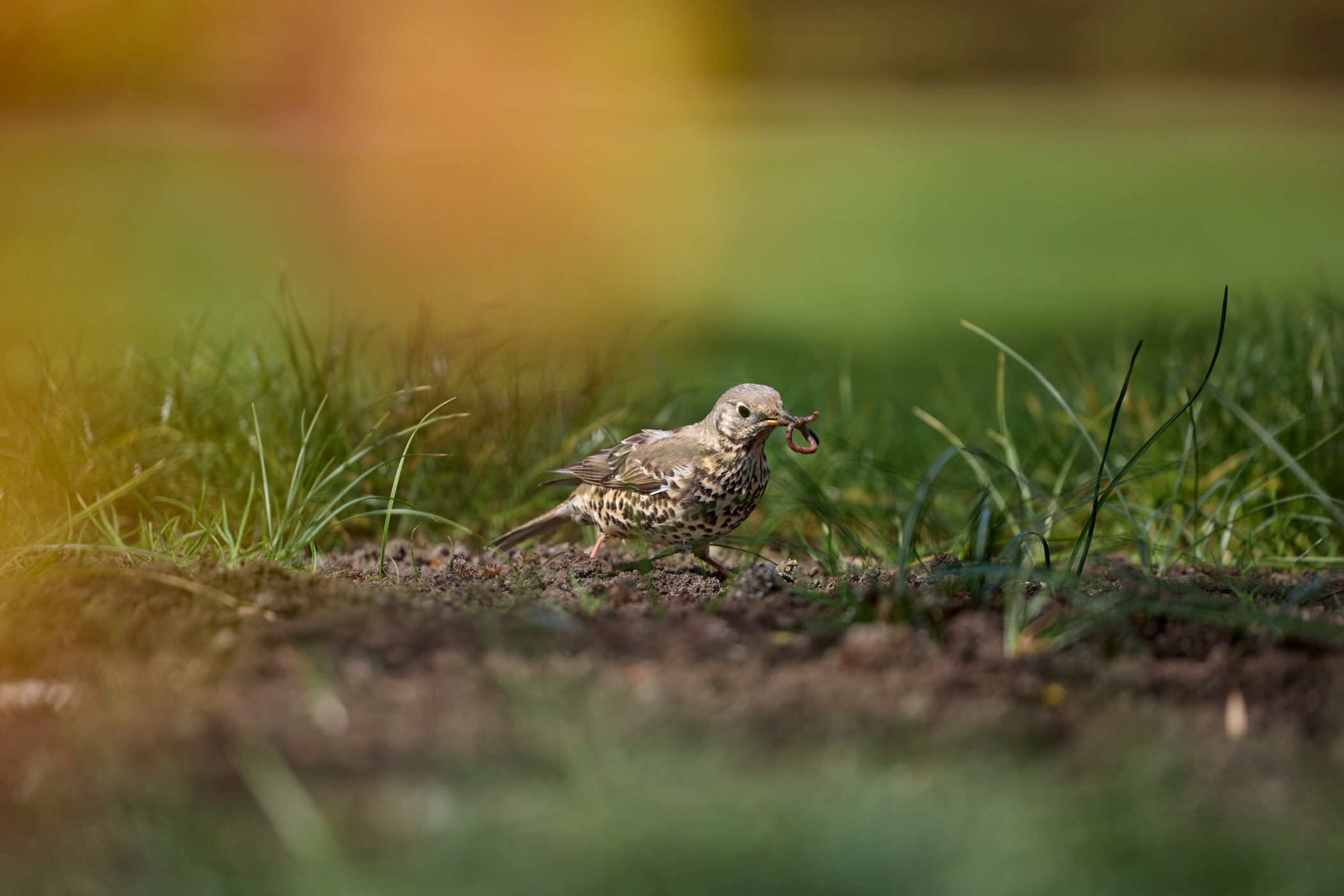 One of the mistle thrushes preparing to feed its chicks. Credit: Charlotte Darvill, Fisher Studios.
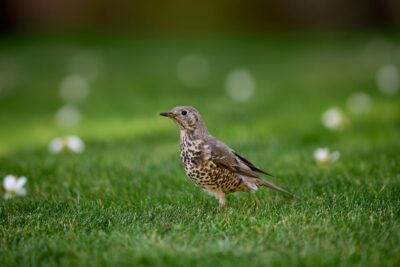
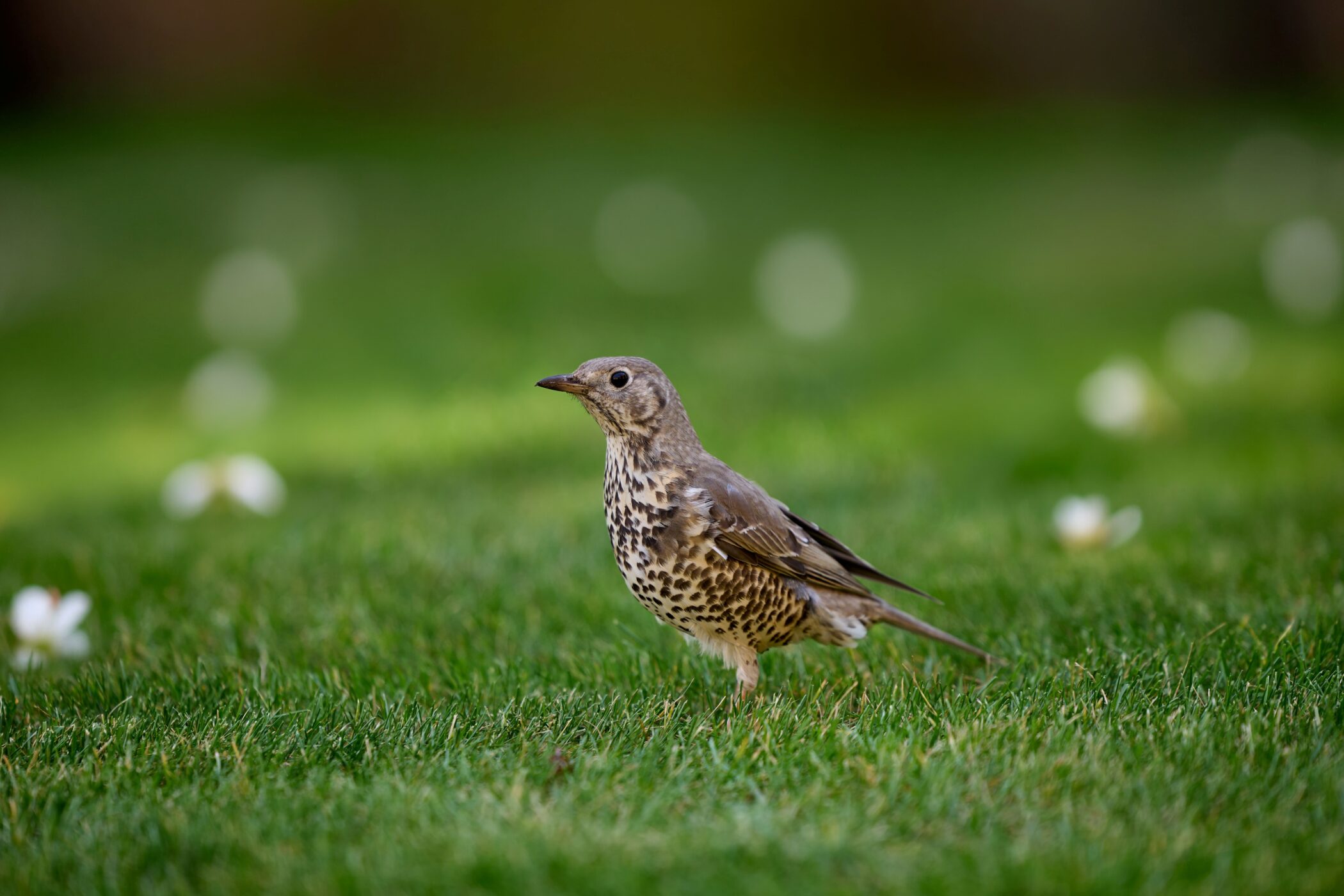 A mistle thrush on Quad. Credit: Charlotte Darvill, Fisher Studios.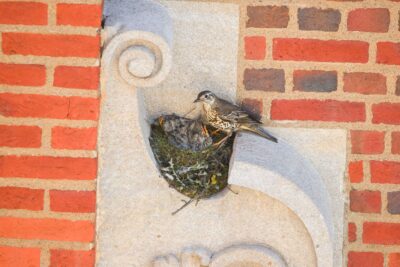
Over the years, these birds have been given many folk names. One of the more memorable is “stormcock”, named for the male’s distinctive song, which is often recited after wet and windy weather. The “mistle” in our name for the species stems from their absolute adoration for the delicious white mistletoe berries (though these are of course toxic to humans), which they will ardently defend should they find a supply. Their love for these berries is of great importance to the mistletoe plant, and its berries have evolved through time to have a particularly sticky nature. The seeds will often become glued to the birds’ beaks or else pass through the bird whole to end up secreted onto the branch of some poor unsuspecting tree host. Mistletoe (Viscum album being the common plant found in Europe) is a hemiparasite which forms a haustorium to infiltrate its host and is enabled to grow upon the bough of a new tree by the consumption and transfer of their seeds by the indulgent thrush.
The mistletoe’s parasitic nature, causing eventual host death, has not prevented the plant from becoming steeped in mythology and religion, leading to its present state as a widespread symbol of festive love. In Greek mythology, the plant was thought to possess protective qualities, being carried by Aeneas as defence during his trek to the underworld, whilse in Norse mythology, the mistletoe was quite the double-edged sword. The trickster god, Loki, fooled Hodor, the blind god, into killing Loki’s twin brother Baldur and a fatal mistletoe arrow was the weapon of choice. The mistletoe berries were thought to be the tears shed by Fridda, the mother of the unfortunate twins, and became a symbol of love in Scandinavia.
Mistletoe was similarly glorified by the Romans, for whom it was a poignant symbol of peace, love and understanding, frequently displayed during Saturnalia, a celebration for the god of wealth, agriculture, liberation and renewal. It was here that the notion of kissing under the mistletoe was first observed. This continued in Christianity during the Middle Ages, where mistletoe represented vitality and fertility and was displayed during the Christmas period. Perhaps the plant’s parasitic nature and tendency to remain green long after its host has lost its leaves for winter has created its strong association with love and life.
Mistletoe’s very name has its origins in an ancient word for “dung twig” due to its most likely method of seed dispersal. The plant’s transmission from tree to tree owes a lot to the mistle thrush and other birds with a shared fondness for its berries. Since the 1970s, the mistle thrush has undergone major population declines and in 2015 was put on the UK Red List, most likely linked with the degradation of farmland habitat and hedgerows. Somerville quad offers an important habitat for our resident pair of mistle thrushes, so keep an ear open this spring for its harsh and wild song.
Nel Wickins is a second-year Biology student and Thatcher Scholar. A keen conservationist since her formative years growing up in the East Devon countryside, Nel is a youth representative for the British Trust of Ornithology, and sits on the committee of the Oxford Ornithological Society.
Update: The Chicks Fledged Successfully!
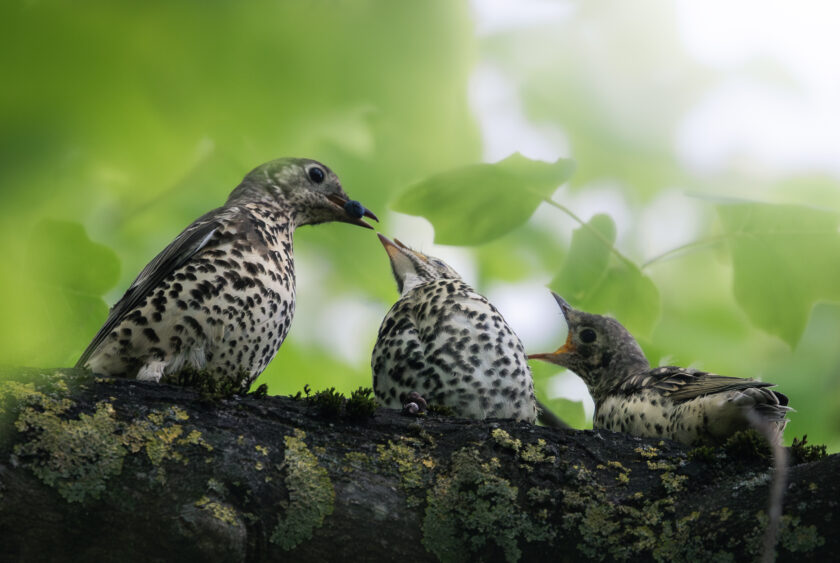
Parent and fledged chicks on the Somerville Quad, April 2026