Dr Lachie Scarsbrook, our Fulford Junior Research Fellow, has published a groundbreaking new study today in Nature, which pushes the earliest evidence for dogs back by more than 5,000 years.
The study, which made the front cover of Nature, uncovers the earliest genetic evidence for the existence of dogs. Using ancient DNA analysis, Lachie and his fellow researchers identified dogs at archaeological sites in the UK and Türkiye which date to the Late Upper Palaeolithic. This period was approximately 16,000–14,000 years ago, a time before agriculture, when all humans were hunter-gatherers. Lachie commented that, “While pushing back the origin of dogs by 5,000 years is ground-breaking enough, what I find truly remarkable is that the close relationship many of us share with our canine companions goes back at least 16,000 years”.

Artistic reconstruction of Pınarbaşı c. 15,800 years ago based on evidence from archaeological excavations by University of Liverpool. The illustration shows dogs, the burial of pups and the local wetland landscape, alongside personal ornamentation, various foods including fish (consumed by dogs), basketry and ritual practices. Illustration by Kathryn Killackey
Scientists have long known that dogs emerged from grey wolf populations, and it was suspected that this process took place around the last Ice Age. However, evidence of dogs from pre-agricultural archaeological sites has been limited and difficult to confirm. This is because during the early phases of domestication, dog and wolf skeletons were likely indistinguishable, and their behavioural differences leave no trace.
Previous studies have mostly used very short DNA sequences and skeletal measurements to evaluate the earliest presence of dogs in the archaeological record. For this new study, by contrast, researchers from 17 institutions recovered whole genomes from archaeological specimens older than 10,000 years, which has been excavated from Upper Palaeolithic sites including Gough’s Cave in the UK, and Pınarbaşı in Türkiye. They then compared the genomes with more than 1,000 modern and ancient dogs and wolves from across the world.
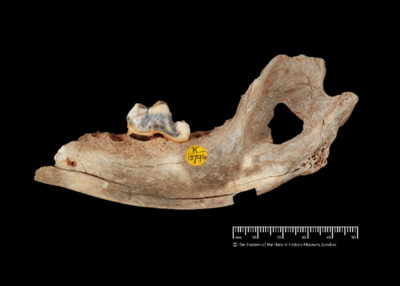
14,300-year-old dog jawbone from Gough’s Cave, UK © The Trustees of the Natural History Museum, London
The results of these analyses confirmed that these bones belonged to dogs, therefore pushing back the earliest direct evidence for dogs by more than 5,000 years. Re-analysis of the earlier data also showed that dogs were likely distributed across Epigravettian and Magdalenian hunter-gatherer communities in Europe toward the end of the Ice Age.
These new DNA data revealed not only that the Gough’s Cave and Pınarbaşı individuals were dogs, but also that they were more closely related to the ancestors of present-day European and Middle Eastern breeds, such as boxers and salukis, than to Arctic breeds like Siberian huskies. This indicates that today’s major dog genetic lineages must have been established by the Upper Palaeolithic period.
Dr Lachie Scarsbrook, our JRF and a Postdoctoral Researcher at the LMU Munich, explains: “This means that by 15,000 years ago, dogs with very different ancestries already existed across Eurasia, from Somerset to Siberia. This raises the possibility that domestication occurred during the last Ice Age, more than 10,000 years before the appearance of any other domestic plants or animals.”
This study, entitled Dogs were widely distributed in Western Eurasia during the Palaeolithic, is published today in Nature and can be accessed here. You can read about Lachie’s previous research here and see a full list of his publications here.