Since it began in 2023, the civil war between Sudan’s armed forces and paramilitary group the Rapid Support Services (RSF) has led to over 150,000 deaths and 12 million people being displaced.
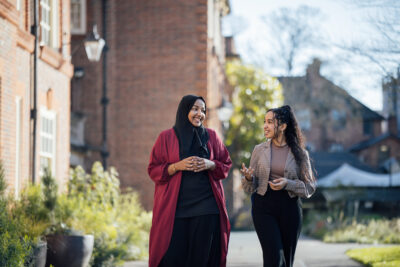
Hadeel (l) and Zeinab (r) in Somerville
In the midst of violence and chaos, doctors and healthcare workers continue working to save lives. This year Somerville welcomed two Sanctuary Scholars from Sudan, Hadeel Abdelseid and Zainab Mohamed, who are already playing a part in these vital efforts.
Now flatmates and good friends, Hadeel and Zainab are both honing their respective training in medicine and healthcare policy, determined to create a better future for Sudan.
Smart Phones and Surgery on the Frontline
Dr. Hadeel Abdelseid is a Sudanese physician and Director of the Sudan ECHO Center of Excellence at SuDRO, a nonprofit organisation building sustainable communities in Sudan. Hadeel is reading for the MSc in International Health and Tropical Medicine.
When the war erupted, my family was forced to leave our home with no destination, carrying little more than a few bags and our faith. We travelled between states, displaced again and again. Those weeks were defined by uncertainty, fear, and a quiet determination to survive.
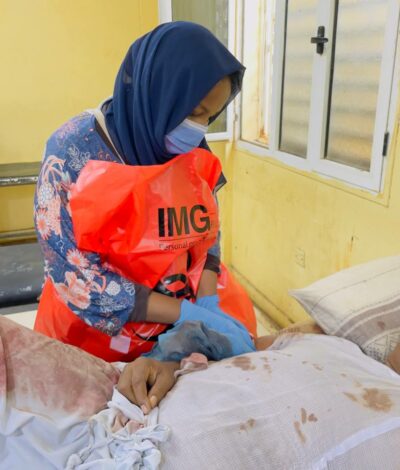
Hadeel Abdelseid attending to a patient in Sudan. Credit: Hadeel Abdelseid
The hospitals I worked in became both a sanctuary and a frontline. Gunfire echoed in the distance; casualties arrived in overwhelming numbers. Yet, even in the darkest moments, the strength of Sudanese communities shone through. I found renewed purpose collaborating with Project ECHO, an international tele-mentoring initiative that connects healthcare workers in crisis settings with global expertise.
With formal training disrupted, many of us relied on emergency protocols shared through smartphones to manage gunshot wounds and trauma cases. I learnt how to leverage what I have to thrive, sometimes wearing a garbage bag to protect myself while treating patients.
In the immediate aftermath of the conflict, we launched the Sudan Emergency ECHO Programme in just two weeks. This remarkable collective effort by displaced volunteers demonstrated how communities under immense pressure can still mobilise expertise, compassion, and organisational strength to support one another.
Through this programme, I helped deliver more than 45 critical care training sessions, reaching over 2,000 healthcare providers across Sudan, ensuring that even as education systems collapsed, frontline workers continued to learn, collaborate, and save lives.
The relentless pressure and danger took their toll, and I was diagnosed with depression and PTSD. At the time when I felt most lost, a close friend encouraged me to apply for a scholarship at Oxford. It seemed unimaginable: how could someone who had just escaped conflict find a place at one of the world’s leading universities? But I applied anyway, guided by faith more than confidence.
Every hardship, every moment of fear, led to this new beginning
Hadeel Abdelseid
The acceptance letter arrived weeks later: a fully funded place at Oxford, to pursue an MSc in International Health and Tropical Medicine, affiliated to Somerville College. I cried with gratitude. Every hardship, every moment of fear, had led unexpectedly to this new beginning.
Today, I carry Sudan with me in every lecture and seminar room. My studies at Oxford are deeply connected to my commitment to global health equity, and I hope to return with the skills to rebuild, advocate, and strengthen healthcare systems scarred by conflict.
Health Technologies that Work for Sudan
Zainab Mohamed is a Biomedical Engineer studying for the MSc in Translational Health Sciences. She hopes to build on her work at the Social Security Investment Authority in Sudan, where she discovered her passion for linking healthcare, policy, and innovation.
When the war broke out again in Sudan, one of the first things the soldiers attacked were the hospitals. But even before the destruction, we were already facing a deep, structural problem in our healthcare system.
In 2022, I was working as a biomedical investigator, evaluating medical equipment across hospital sites. Everywhere I went, the pattern was the same. The government had invested in expensive medical machines imported from abroad, designed for countries with controlled climates and stable infrastructure. In Sudan, even before the machines were turned on, dust and heat had already compromised critical components.
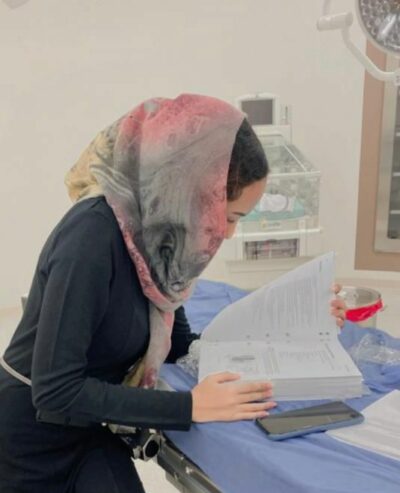
Zainab works on an incubator, now destroyed by the RSF, in July 2021
Standing in rooms full of equipment that cost millions, but could not save a single life made something very clear to me: we cannot build a strong health system on technologies that were never designed with us in mind. That experience sparked my commitment to finding locally driven solutions that work for low-resource health systems, not around them.
I applied to Oxford because I want to address this problem at its root, and the MSc in Translational Health Sciences offered the perfect means to do so. An interdisciplinary course for healthcare professionals and policymakers, it teaches students how to influence the adoption of new healthcare technologies at every level.
For me personally, it offers the chance to learn why technologies fail in countries like Sudan, and how they can succeed when built locally, for local realities. Small design decisions – materials, filters, maintenance needs – determine whether a device survives months or fails in days. In our context, a single failing machine represents not just wasted money, but lives lost.
My goal is to help Sudan develop its own technology-transfer and innovation ecosystem. We currently lack our own regulatory pathways for translating biomedical ideas into usable health technologies. But I believe that our researchers, engineers, and entrepreneurs have the creativity and expertise needed to change that, if we build the right structures around them.
I hope to contribute a roadmap for making this change possible: linking research, policy, and manufacturing so that the next generation of biomedical solutions in Sudan are sustainable, maintainable, and truly designed for the environments where they will be used.
To support our Sanctuary Scholarships, please contact sara.kalim@some.ox.ac.uk