This Michaelmas, we have welcomed a new Chapel Director to Somerville: Dr Joel Clarkson, who joins us from a background in Theology and musical composition. We sat down with Joel to ask him some questions about how he’s finding College, and everything that lies ahead…
Welcome to Somerville! What’s your impression been of the College so far?
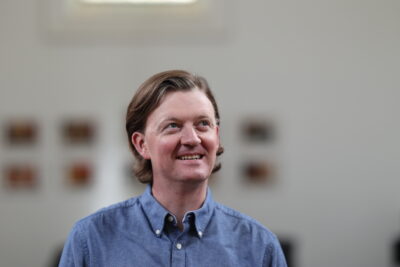
I’ve really enjoyed my first weeks at Somerville. I’ve lived in Oxford for a number of years but this is my first time having a formal connection to the University. Even in my short time here, I can already tell that Somerville is a special place. As Chapel Director I’ve been gaining a sense of the unique multi-faith nature of our chapel, which is intentionally designed as a place for people of all faiths and none. I think that sense of belonging within diversity is what has most impressed me so far. We all come from different backgrounds and cultures, and with varying perspectives on life and faith, and we have the privilege of bringing that gathering of experiences here to share in our community life together.
You’ve had a really interesting journey in academia and in your professional life. Can you give our readers the potted history, and how your path has led you to Somerville?
It has been quite the adventure! After studying music composition at Berklee College of Music in Boston, I spent time in Los Angeles for several years developing a career as a composer and orchestrator for film and TV. During that time, I was privileged to work with some amazing people, including composer Joseph Julian Gonzalez. Joseph invited me to collaborate on new orchestrations for his celebrated oratorio Misa Azteca, a multi-movement piece for orchestra, choir, and Mexican percussion, and which combines aspects of the Catholic Latin Mass with Nahuatl (Aztec) poetry. I was captivated by both the sacred and cultural dimensions of the piece, and recognised what a profound power music has to shape both how we know ourselves and how we shape our lives. I realised I wanted to pursue further study related to the questions I was beginning to ask about my own musical practice.
I eventually found my way to the Institute for Theology, Imagination and the Arts at University of St Andrews, where I completed both a Masters and a PhD with a focus on music and theology. I graduated in 2023, and since then, have enjoyed the chance to research, teach and speak on topics relating to spirituality, artistry, music and beyond. I’ve also returned to my compositional career, pursuing a new pathway of writing choral works for both sacred and concert settings. Somerville Chapel is a wonderful convergence of the things I love the most: pondering fascinating questions about faith and philosophy; pursuing meaningful community; and a healthy dose of music thrown in for good measure!
Your academic research has focused on the relationship between music and theology. How has your personal understanding of the connections between music and faith developed from this, and how do you see this relationship shaping the life of Somerville’s Chapel?
If you want to get me talking for an hour (or three), this is the million-dollar question! There are so many things I could say, but one thing which really stands out for me is simply the way in which music, which can seem so immaterial, moving in and around us, so grounds us physically in the world. I am a massive fan of music for the voice, because I think singing really brings this home. The choral music we hear each week from the Somerville College Choir, which so lifts our spirits, is only produced through profoundly embodied activity: muscles attuned, lungs expanding and contracting, air streaming over vocal folds. It communicates the reality that what we might call the spiritual or numinous isn’t about escaping our materiality. Rather, our senses are the very means through which we are able to perceive the beauty that evokes that sense of profound transformation for us. The Chapel is already rich with sensory expression through our weekly Choral Contemplations, and our Wellbeing offerings are also time-honoured embodied practices. As an active artist in my own right, I especially hope to foster an arts-forward approach, which welcomes creative expression of various sorts as part and parcel of our community life together.
Though we may come from many faith and non-faith perspectives, all of us have the same longing to belong.
Joel Clarkson
Somerville’s Chapel was founded as a ‘house of prayer for all people’. As a Christian yourself, how do you intend to cultivate inter-faith community at Somerville, as well as fostering a welcoming space for non-religious members of College?
At the heart of my own faith is the belief that all of us are made for communion – genuine and life-giving relationships with God, each other and the world around us. Real relationships, the kind that grow into something lasting, aren’t built on one-sided conformity, but on an earned trust that honours the uniqueness of every person. And that kind of trust can only grow when every person knows that they have a voice. Though we may come from many faith and non-faith perspectives, all of us have the same longing to belong, and to have real connection with others.
I have come to believe that developing multi-faith community begins with seeking real and lasting friendship, driven by a desire to grow in trust, to listen well, and to learn from each other. We don’t need to leave behind our views or experiences; instead, the more we walk alongside each other in friendship, the more we are able to listen to other perspectives with genuine attention and admiration. My hope as Chapel Director is to cultivate that kind of space, a space where we grow in friendship so as to truly see, hear, and care for each other in our diversity.
Do you have a favourite place to listen to choral music in Oxford (aside from the Chapel, once our students have returned!)? And more generally, are you enjoying life in Oxford so far?
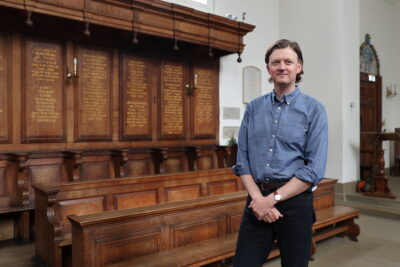
Life in Oxford is amazing! Something I particularly love is the healthy balance between ‘town and gown.’ I’ve lived in Oxford for five years, and this is my first foray into life in a College. I’ve loved the experience of being a regular resident of this amazing city – walking its streets, hanging out at my favourite restaurants, spending time strolling along the canal or watching the ducks swim on the pond in the University parks. As a nature lover and an avid countryside rambler, I especially appreciate that within about twenty minutes, almost no matter where you are in the city, you can be in an open field or along a riverbank. I feel incredibly fortunate to be able to now combine that experience with a rich college life at Somerville.
As for choral music in Oxford, we are truly spoiled for riches. I have enjoyed singing regularly in a number of choirs in Oxford, including both college choirs and church ensembles, and love attending Evensong and Compline services in many college chapels. I’m especially a fan of Lessons and Carols services for Advent and Christmas. I’m delighted that we have our own unique Carol service here at Somerville, which we’ll enjoy in 8th week. (Make sure to mark it in your calendars!)
Is there anything in particular you miss about the US, having been based in the UK for some years?
It’s an interesting question for me to ponder as I close in on a decade of life in the UK. From a cultural perspective, something happens after spending a couple of years outside of your home country. You begin to realise you are no longer precisely what you were before you left home, and yet, even as your new community welcomes you and you begin find your way into its patterns, you also aren’t exactly becoming a carbon copy of that identity either. You begin to occupy a third space (or a third culture, as it’s perhaps more commonly labelled).
In a way this is something I’ve experienced throughout my life. Even though I grew up in the US, I was born in Austria, and my family moved frequently throughout my childhood. I’ve kept up the same breathless pace in my own adulthood, moving coast to coast in the US and now living here in the UK. Over time I’ve learned that the best way to find grounding in a new place is go deep quickly with rhythms of normal life that you can find just about anywhere in the world: genuine friendship, good food, long walks outside.
In that sense, when I think of the US, I think about Colorado, where my parents live, and the people and things I cherish the most there: dear friends; the rhythms of life with family; home-cooked meals around a table, replete with laughter and joyful conversation; the crisp, sharp taste of Rocky Mountain air and the scent of pine lingering from an afternoon thunderstorm.
I know that so many of our Somerville community, whether they have come from nearby or are travelling from the other side of the world to be here, are perhaps sharing in that feeling of being in uncharted territory. I understand in a very personal way what a journey that experience can be. I hope that the chapel can be a grounding place for all of us, where we can bring our different stories into our patterns of life together, so that all of us can thrive during our season here.
Are there personal projects (academic, musical or otherwise) that you hope to spend time on during your time at Somerville?
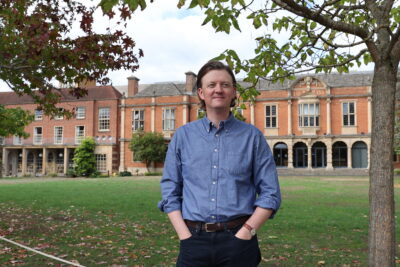
My scholarship focuses on the particular stylistic approaches composers employ to convey spiritual meaning. I have forthcoming publications related to this area of study, and hope to continue developing longer projects presently in the works, on the topic of music and theology. Given the week-to-week opportunity the chapel provides to experience beautiful choral music, I can’t think of a better place to pursue such research.
I’m also excited to continue managing an active slate of commissions, premieres, and performances of my own original compositions. My present compositional approach is very much driven by a desire to integrate what I’ve learned in my theological studies into my composition. I’ve been privileged to work alongside some truly amazing artists and ensembles, and I look forward to continuing to do that in my future work as well.
Alongside my research and my music, I also regularly write and speak in general interest settings on spirituality, artistry, music, culture, and more. I find communicating in these mediums is a fantastic way for me to gather everything in my life into a distilled snapshot of my view of the world in a given moment. In a very real sense, what you hear from me when I give a reflection in chapel is drawn from this synthesis of research, creativity, and communication. Life imitates art, and vice versa!