On Earth Day 2026, we launched a special online series called Green Fridays at Somerville. At its heart was a simple question: what forms of sustainability-related work, care and curiosity are already present within the College community? MCR Sustainability Rep Ashima Gulati reflects.
The series was created for Somerville’s social media channels, with each week’s feature offering a glimpse into a different connection with nature, sustainability and climate. Some took us into forests and field trips. Others stayed much closer to home, in the gardens, allotments and green spaces that many of us pass through every day. Some looked beyond Oxford altogether, to restoration work overseas and community-led climate education in India.
For those who followed the series online, these were short visual stories. But, taken together, they suggested something much broader about Somerville. Sustainability here is not limited to formal climate research, advocacy or policy. It appears in the way students learn, in the way shared spaces are cared for, and in the way Somervillians carry their environmental and climate concerns beyond College.
One dimension where this was seen clearly was in research and learning. Several Green Fridays features showed students engaging with sustainability not only through lectures and readings lists but through fieldwork, observation and direct engagement with landscapes.
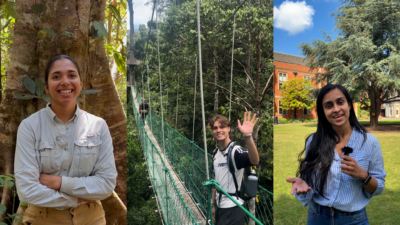
Tanaya, Myles and Nethmi
Tanaya’s work with forests highlighted the complexity of ecological systems. Forests can be described in terms of carbon, biodiversity or conservation, but they are also places of roots, species and changing living conditions. To study them closely is to learn from living systems rather than reducing them to a single function.
Nethmi’s work on heat and cooling brought the question into the spaces where people study, work and live. Extreme heat is one of the most immediate ways climate change is now being felt but the ability to cope with it is not evenly shared. Housing, water and access to green space all shape who is protected and who is exposed. Cooling, in this sense, is not only a technical issue. It is also a question of inequality, infrastructure and public responsibility.
Nel and Myles’ nature-based field trip showed another form of learning that comes from being in a landscape. Field trips are sometimes treated as extras to environmental education but they can change what students notice. Walking through a place, observing relationships between species and seeing environmental change in context can make ecological systems feel less distant and more connected to everyday life.
Together, these features presented sustainability as a way of asking better questions about landscape, inequality and the forms of knowledge needed to respond to environmental and climate change.
A second dimension of Green Fridays brought the focus back to Somerville’s everyday spaces. Here, sustainability appeared less as a research question and more as stewardship, in essence the work of caring for the places we share and the forms of life that exist alongside us.
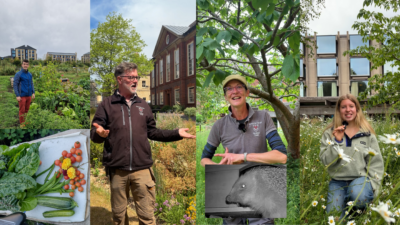
Tim, Alastair, Anna and Jess
At his allotment near Port Meadows, Tim spoke about raised beds, seasonal vegetables, reused materials and the satisfaction of growing food. There was something unique in this. Sustainability does not always have to have a grand gesture. Sometimes, it begins with basic elements like soil, patience and the decision to repair rather than to replace.
Within College itself, the gardens became a central part of the story. You ask any Somervillian about their favourite place in the College, the central quad would always be at top. Through Alastair and the gardening team’s hard work, the gardens appeared not only as beautiful spaces but as living habitats shaped by care. Ponds, rewilded areas and biodiversity in the College are not accidental. They require knowledge, hard labour and continued attention. Much of this work is easy to overlook, especially when it is done so well.
The hedgehogs in Anna’s feature drew our attention to the co-inhabitants of the College. Suddenly the College grounds were not only our paths but also routes of movement, shelter and habitat for species most of us rarely see. To think about hedgehogs and their habitats is to think about the small design choices that can make urban spaces more permeable to other forms of life.
Jess’ work on worms and soil moisture took this attention beneath the surface. By counting worms and studying the conditions in different parts of the garden, she made us see life under our feet. Soil health and moisture may not be the most visible parts of sustainability but they are among the most fundamental. They remind us that the health of a place often depends upon what is not immediately visible.
Seen together, these features made us look again at Somerville’s everyday environment. The gardens, allotments, and habitats are not just side notes to sustainability. They are part of how a community learns to live with more care for the place it inhabits.
The third dimension of the series was to look outwards. A few features of the Green Fridays showed us how Somervillians carry environmental and climate questions beyond the College, into other landscapes and communities.
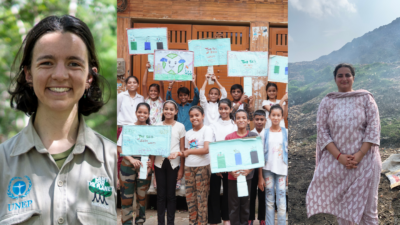
Anna and Ashima, as well as a group of children Ashima worked with on a climate change education programme
Anna’s work with Plant-for-the-Planet took us to a restoration site in Central Mexico, where sustainability meant seed viability, field visits and the long-term question of whether trees can survive in the actual conditions of a landscape. Her story challenged any simple idea that restoration is only about planting trees. It showed ecological repair as patient, technical and sustained work, tied to wider questions of climate justice and responsibility across borders.
My own contribution came from the work I had done before joining Oxford with children living near the Bhalswa landfill in Delhi. In partnership with a local NGO, we co-created with children a climate change education programme rooted in their surroundings, language and lived experiences. The children were growing up with polluted air, contaminated water, extreme heat and waste as part of everyday lives. Through hands-on-activities and creative expressions, these children carried climate knowledge beyond the classroom and into their communities.
These stories mattered because they showed that sustainability at Somerville is shaped not only by what happens within the College but, also by what members of the community bring with them and carry forward.
This is what Green Fridays helped make visible. Sustainability at Somerville is not one discipline, one career path, one campaign or one kind of a person. It can be academic, practical, personal and communal. It appears in forests and field trips, in research on heat and inequality, in allotments and gardens, in hedgehog habitats and worm counts, in restoration work and in climate education with children.
Most importantly, the series reminded us that sustainability often begins with attention, especially to the places we inhabit, to the species we share space with, and to the communities to which we remain connected. In that sense, Green Fridays has become more than just a social media series. It became a way of seeing Somerville differently, through the relationships between people and place, research and practice, everyday habits and larger climate and environmental questions, within College and far beyond it.