Dr Kieran Brown is one of two inaugural recipients of an early career fellowship under Somerville’s newly created Early Career Fellowship Fund. A specialist in the newly emerging field of the economic humanities, Kieran has published widely on modernism, economy and critical theory. As the Sue and Kevin Scollan Early Career Fellow, Kieran will tutor Somerville undergraduates in literature from 1830 to the present.
You’ve had an interesting route into academia, studying both economics and literature before committing to them in tandem. How did that come about?
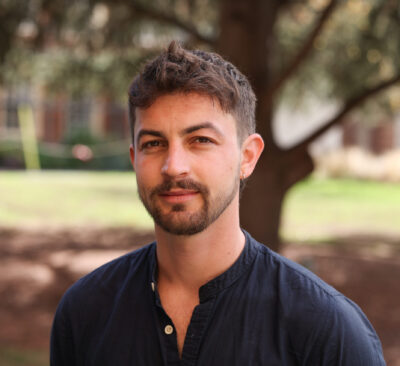
Kieran Brown
The two interests always went hand-in-hand for me. I majored in economics and literature as an undergraduate at the University of Cape Town. After graduating, I stayed on to do a year-long honours course in literature, which is a standard step in South Africa before your Master’s. Less conventionally, I then decided to go back and do another honours course in Economics. My plan at that stage was to apply the two disciplines together by working for an NGO back in South Africa. However, while doing my Master’s in Literature here at Oxford, I realized there were certain questions that remained unanswered and that I felt almost compelled to work out through further study.
Your research sits at the intersection of literature, economics and philosophy. What exactly are the economic humanities, and why did the field appeal to you?
Before offering a definition, it’s probably a good idea to zoom out a bit and note that, although the economic humanities defines itself as a new field, it does so by claiming that it’s actually always existed, and that people have in fact always been interested in this area. If you go back to Goethe, for example, you’ll find him saying that words are as valuable as money; if you read Nietzsche’s On the Genealogy of Morality, you’ll find him saying that all thinking begins as a financial imperative, and that guilt, like original sin, begins as a debt. Every time I came across a nugget like this, I got excited and wanted to write about it. Over time, I became aware that there was a deep well of people who had been thinking about this exact topic for centuries – and that now it had its own discipline.
Who are some of the key figures in the economic humanities?
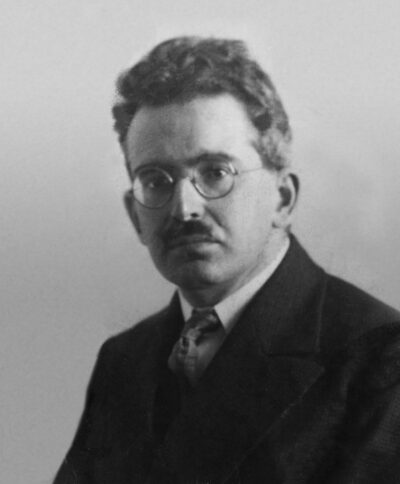
Walter Benjamin, 1928. Source: Akademie der Künste, Berlin – Walter Benjamin Archiv
There are many writers whose work is aligned with the economic humanities, figures like Ezra Pound, who was infatuated with economics for the latter half of his life, and Ferdinand de Saussure, who defines value as a fundamentally linguistic process in political economy. Then there are the real sort of twentieth-century titans in the field: the semantic materialist Ferruccio Rossi-Landi, who describes linguistic activity in terms of material processes, and Jean-Joeseph Goux, whose Symbolic Economies is the foundational text of the economic humanities. Finally, I have to mention Walter Benjamin, the great German-Jewish philosopher and cultural critic who has become one of my most important intellectual influences. He’s not usually associated with the economic humanities, but I think it’s almost impossible to understand him or his writing without appreciating just how linguistic he thinks the economy is.
So how would you define the economic humanities, and what they offer?
In essence, the economic humanities propose to use the tools of the humanities – like linguistic and literary analysis, history and philosophy – to try and understand economic systems. At the same time, it also offers to do the reverse, by using economics to understand cultural systems. An example would be how changes to the production of writing systems shape the form and content of writing itself, whether that’s the invention of the printing press, the advent of TV and radio, or the increasing adoption of AI. The fact that recent archaeological discoveries suggest the first writing systems in history were used not for transcribing poetry or myth, but the rather more mundane purpose of tracking debt seems to confirm the fundamentally entangled relationship between economy and language; that we trade symbols as much as physical objects.
You’re the inaugural recipient of a Somerville Early Career Fellowship. Why do you think schemes like this are so important?
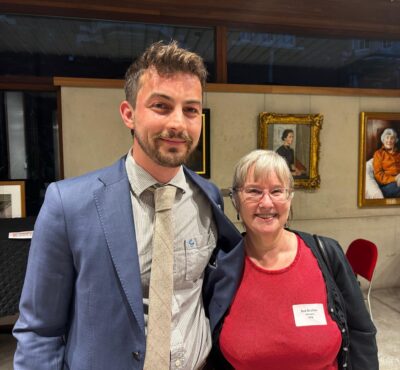
Kieran Brown and Sue Scollan
Well, the first thing I’d like to say is how grateful I am to Somerville and to Sue and Kevin Scollan for enabling this fellowship, and choosing me as its recipient. The second point to note is that early career fellowships have historically provided an important bridge between completing your DPhil and starting on a tenured academic position. They developed in response to the fact that mastering one’s chosen academic field requires dedication: it takes time, and therefore money, to produce any work of long-form criticism, and to prove your ability to contribute to your chosen field. Now, sadly, the pressures on that early career phase are becoming worse than ever, making this form of support even more crucial.
There are several key challenges. Firstly, there are now many fewer jobs than before – the British Academy recently reported a 20% decline since 2016 in the number of Early Career Researchers in the humanities. Fewer posts mean fiercer competition, with most new fellowships receiving hundreds if not thousands of applications. The other knock-on effects of competition are that people now either have to spend longer in this deeply precarious early career phase, or they leave academia for better-paid jobs in other sectors. Finally, scarcity and increased competition have created a phenomenon known as CV inflation, which means that the burden of expectation placed on early career academics to prove their impact has gone up. In the past, for example, you might have been expected to have one article out by the time you finished your PhD. Now the expectation is that you’ll have six or seven articles out, or a book under contract.
And how do these stresses impact early career academics?
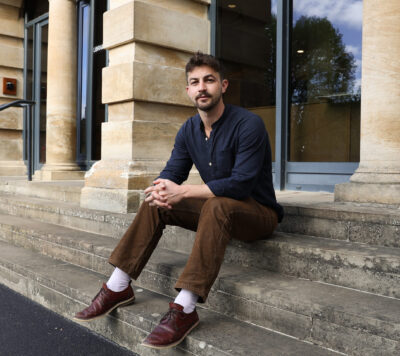
Kieran outside Somerville Library
The combination of job scarcity and competition has pretty much turned early career academia into a gig economy, especially in the humanities and social sciences. Unless you come from a privileged background, you’re forced to cobble together multiple teaching jobs or shop around outside academia to make ends meet. Living so precariously places a relentless pressure on your capacity to do the sustained thinking you need in order to prove yourself and justify your research.
What happens if we don’t support early career researchers through programmes like this one?
I think there are three significant consequences. The most immediate one is that the pipeline of future researchers will break down as we lose this generation’s most talented scholars to other professions. The second is that a loss of tutors will mean there’s no one left to steward in a new generation of humanities students, with all the damage to research, cultural production and creativity that entails. Thirdly, it seems to me that, as our lives become more optimised and subject to the demands of AI and the market, we risk losing what for thousands of years has been a defining feature of human life. That is, we will lose the personal and social benefits of reflecting on the fact that we are, in essence, self-reflecting creatures. This is what the humanities offers, and there is a clear jeopardy in that, by using AI to think for us, we will forfeit the task of thinking as such.
Do you think that academic research like your own can help us to preserve the humanities?
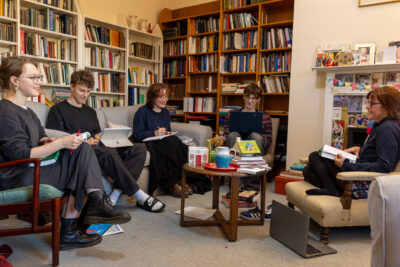
English undergraduates discussing ‘Beowulf’ with Professor Annie Sutherland
Ah, that’s an extremely knotty question. Well, the first thing to make clear is that the humanities has always existed in the form of a community. Whether that community is an institution or not, the assumption is that it’s only possible for individuals to preserve these ways of thinking through some form of social relation – the sharing of ideas and so forth. If the present decline in the university sector continues, we stand to lose a great part of that. The idea I’m trying to get at is that the humanities is probably less dependent on individual scholars, like me, and more on the establishment of small, dedicated groups. Sometimes called “privatissimums”, these are groups are comprised of people with shared interests, not necessarily the same opinion, who are able to robustly discuss questions and share ideas. What we’re doing now is a continuation of that tradition and, even under pressure from economic and social change, I am hopeful it will last.
Last question. Do you think specialising in the economic humanities has given you a clearer perspective on the value of the humanities and the work you do?
Undoubtedly. I first became interested in the economic humanities because I sensed that the study of language and literature had an important role to play in helping us pin down this incredibly slippery and symbolic system that we know as the modern economy. Now, with the benefit of the work I am doing, I am more confidently able to interrogate the notion of value. After all, value is itself a social and historical construct. So, I would say that if we try and affix value to the study of language and literature, we risk putting the cart before the horse; it is the job of language and literature to question how that word ‘value’, with all its associated symbolic baggage, comes into being, not the other way round. Another way of putting it is that we shouldn’t think about what the humanities can teach us for other parts of our lives. The humanities is a form of life itself.